On this page:
Efficiency, COP, & SCOP
With a standard electric heater you generally get 1kWh of heat energy for every 1kWh of electrical energy that it uses. A heat pump can typically give you at least 3 times that, i.e. for every 1kWh of electricity that you use, you get 3kWh of heat – and often quite a lot more. This ratio is called Coefficient of Performance (COP) and is quite simply based on the amount of heat you get out compared with the amount of electricity that goes in. So in this case it would be a COP of 3. When you measure the average COP over a period of time, this is called the seasonal coefficient of performance or SCOP.
But in order to get this kind of COP (sometimes up to 5 or more) you need the heat pump to be heating the water in your central heating system to a lower temperature than you would have in a typical boiler based system. This is called the flow temperature and with a heat pump to work as efficiently as possible, the flow temperature needs to be as low as possible – while still capable of heating your home. Underfloor heating is ideal as it is designed to run at much lower temperatures than radiators.
Radiators
When switching from gas to a heat pump it’s quite common for the installer to suggest that you get more or bigger radiators, especially if underfloor heating is not a viable option. This is because in order to get the better COP numbers, heat pumps are generally designed for those lower flow temperatures mentioned above, especially when compared with gas boilers that can typically run at 60º or 70º.
Normally a heat pump installer would measure your house and do heat loss calculations in order to see if you do need more/bigger radiators to cope with the lower flow temperature. However if you are thinking of getting a heat pump you can get a rough idea for yourself by setting the flow temperature of your boiler much lower on a cold day to see how well you can heat the house with a flow temperature of 40º – 50º. In fact many gas boilers are also more efficient with lower flow temperatures so even if you aren’t (yet) running a heat pump it’s worth turning the boiler down a bit for higher efficiency. Note that you may need to make sure all the radiator TRV valves are fully open.
Although some heat pumps can run at high temperatures, you will lose out on the main advantage of a heat pump over conventional electric heating, i.e. the amazing efficiency of which they are capable when configured properly.
Weather compensation
I first heard about “weather comp” when we had a condensing boiler installed about 10 years ago and the plumber mentioned that the weather comp would adjust the water temperature based on the the ambient temperature (i.e. the temperature outside). I remember thinking “what’s the point of that as long as the thermostat is doing its job, won’t we be warm enough?” And so we were. However back then gas was way cheaper than it is today and people were less bothered about efficiency, nor were they so aware of any climate change crisis.
Why do I need weather comp?
Historically, when installing central heating, many plumbers (aka heating engineers) would set the flow temperature quite high, e.g. between 60° and 70°. This is because the last thing they want is the customer calling them back two days later saying they are not warm enough. We are finding that this is also true of heat pump installers. They initially set the flow temperature weather comp set points on the high side so that the temperature of water is more than enough to warm most houses. In this case the actual temperature of the house would then be controlled by either a master thermostat (e.g. in the hall or lounge), individual radiator thermostats or both. Think of it like this:
- On a very cold day the hot water in the radiators is hot enough to keep the house warm
- On a mild day the hot water in the radiators is more than hot enough to keep the house warm so what we have is either:
- a master thermostat that acts as an on/off switch. It turns the boiler off when the house is warm enough, then on again after it has cooled down due to the inherent heat loss; or
- thermostatic radiator valves which regulate the temperature of individual radiators by restricting the flow based on the temperature of the room.
This works of course but is inefficient for two reasons:
- Boilers (especially combi boilers) and heat pumps are less efficient at higher temperatures.
- They may be less efficient when frequently turning on and off.
So in an ideal world what would happen is the flow temperature would automatically adjust so that it is just hot enough depending on the outside ambient temperature, but no warmer. This is weather compensation – the flow temperature is regulated so it changes depending on the weather. In theory, if it is doing this job perfectly, you would never need thermostats – and in many cases this can be true.
Can’t the installer just set it up in its most efficient setting?
Sadly this is not usually possible, especially in a retrofit situation where the heating system was not part of the original house design. But first of all, we should look at a typical weather comp setting which would have a low and high temperature (“set points”) for corresponding high and low external weather temperature. So the colder it is outside the warmer the flow temperature, the warmer it is outside the cooler the flow temperature – but ideally still warm enough to heat the house.
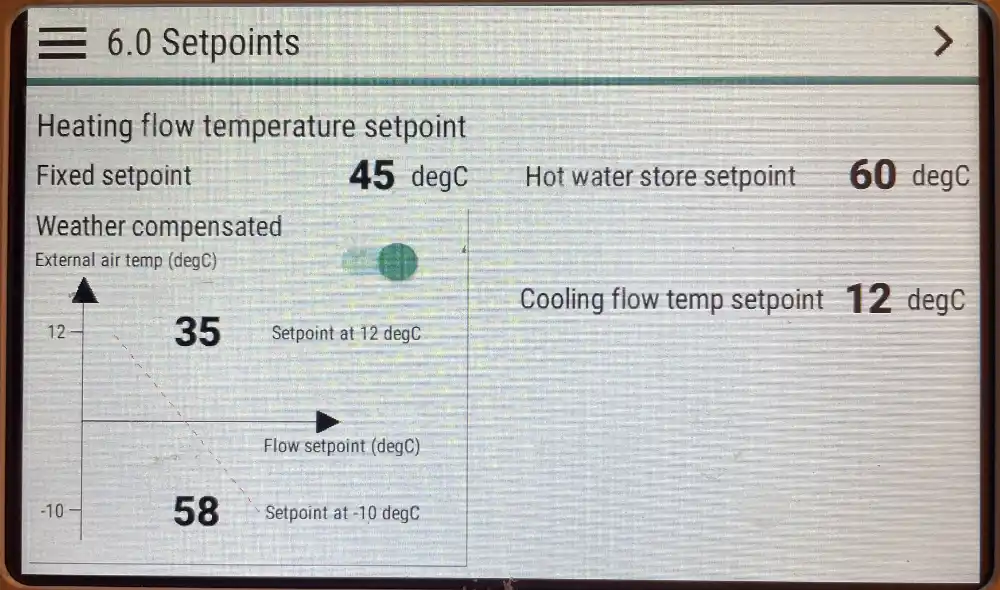
In the above readout, you can see two weather compensation setpoints: 35 and 58. We’ll call these the warm and cold setpoints and the setting above we’ll call 35/58.
- 35 = The flow temperature (water sent out from the heat pump) will be 35º when the outside temperature is 12º (the warm setpoint)
- 58 = the flow temperature will be (a much hotter) 58º when the outside temperature is -10º (the cold set point).
At 0º it will be somewhere between the two, ie around 48º
(Note that with this heap pump you also have the choice to use a fixed flow temperature, ie the fixed setpoint)
How to find the ideal setpoints.
This isn’t always straightforward and depends on several things
- How much heat loss is there in your property?
- What is the output from the radiators? (this depends on how many, what size as we mentioned above)
- How warm do you like your house?
So we have too many variables for even the most experienced installer to know at the time of installing. It may be possible for a new build where the installer/designer can know the heat loss very accurately. In this case the householder may just need to tweak the settings very slightly to suit their own comfort levels. But with a retrofit, the best way is by good old trial and error over a period of time. What we are aiming at is the lowest temperature while still making your house comfortable and avoiding the on/off situation you get with the thermostats.
Take out the thermostat
No, not literally – it could come in handy at times for a variety of reasons, but for now the first thing to do is remove the thermostat from the equation, by setting it to a higher temperature than you normally would have. So for example if you like 20º then set it to 22º and open all the radiator valves fully. By doing this the thermostat will keep the heating on and so allows you to control the temperature of the house purely by the current flow temp. (Although if you have some rooms that aren’t used much, e.g. guest or box rooms, there is no harm in turning the valves down and closing those doors)
You may immediately find the house is too hot, in which case turn down the weather comp. Try lowering both warm and cold setpoints by 3º. Using the above example of 35/38 you would change it to 32/55. Within a few hours you should know if further adjustments are needed. If this now seems to be OK, then leave it for a while (maybe hours/or days). Adjust this until you find that the house temperature is comfortable. The heat pump will be on constantly but at a low flow temperature and so working very efficiently.
However it’s not quite that simple. If you did the above during a cold spell and it suddenly gets a bit warmer outside you may find the house is too warm. This is where you need to think about adjusting either one of the set points or the other. In this case you could try lowering the warm etpoint and reducing the lower, e.g. from 32/55 to 30/57
You should keep a record of the settings and the outside ambient temperature and over a period of time you should be able to find the best set points so that your house is always at just the right temperature while maintaining the lowest flow temp.
If individual rooms are too warm, then you may want to turn down the TRVs. It may be that you turn some right off. Sometimes in winter upstairs rooms get enough warmth through the ceiling below or in the case of a hallway, air rising up the stairwell. This is especially the case with a well insulated loft.
How to tell if the heat pump is still being controlled by the thermostat, ie is going on and off or staying on?
The most obvious way to tell is to:
- keep checking the thermostat as most usually have an indicator
- keep checking the heat pump panel
However another way we found to check historic use is via your meter readings (assuming you can see the daily stats). We found that the house uses between 300 – 500 Watts without heat pump so we can get a rough idea of when the heat pump is on as it usually draws between 1.5kWh and 3kWh. Our Inverter readout is quite handy for this:
With thermostat set for house temperature (between 8 am and 6 pm)
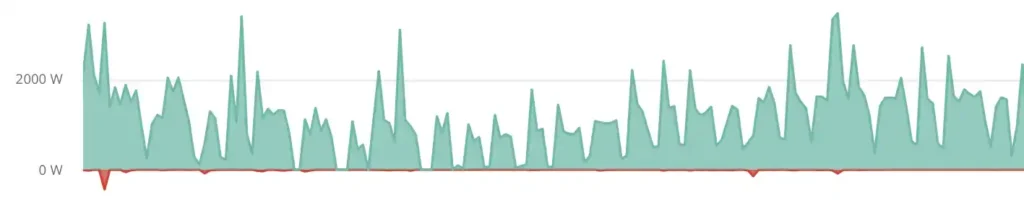
Using weather comp alone for regulating the house temperature:

You cannot immediately compare these two because they were on different days, but you can see the difference between the on/off situation with high flow temp and thermostat to regulate it, as opposed to not using the thermostat and instead keeping the heat pump on but with low enough set points to regulate the temperature.